


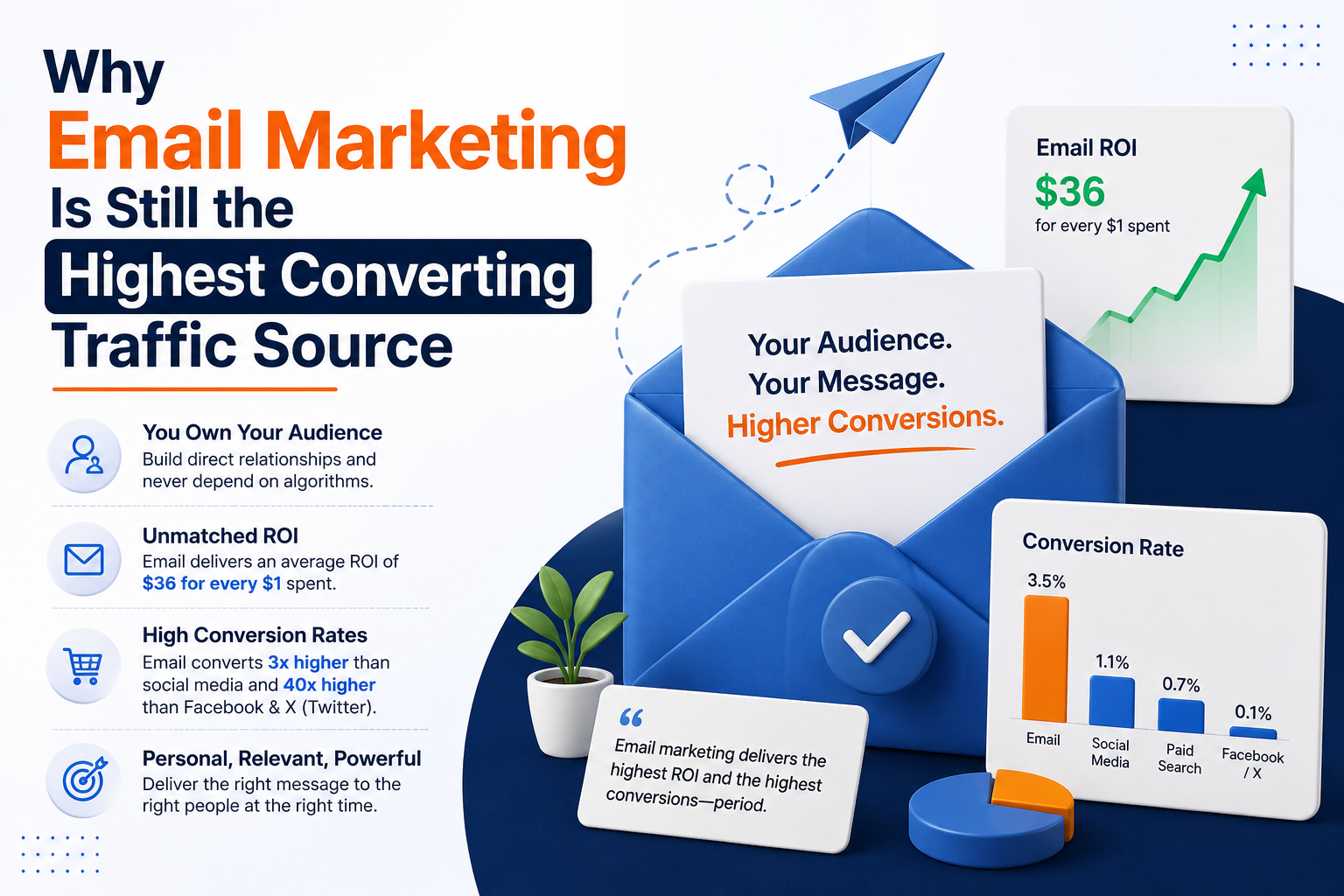
You struggle to turn website visitors into paying customers. Email marketing returns $36 to $45 for every $1 spent in 2026. This post shows why Email Marketing Is Still the Highest Converting Traffic Source, and gives simple steps for personalization, automation, and better targeting to boost conversion rates, ROI, and lead generation.
Read on.
Key Takeaways
- Email marketing delivers the highest ROI among all digital channels, returning $36 to $45 for every $1 spent in 2026.
- Campaigns achieve strong conversion rates: 4.29% on average, with B2C brands at 2.8% and B2B companies at 2.4%, according to First Page Sage and cited data.
- Personalization and automation tools boost engagement by sending relevant messages to targeted audiences, helping businesses generate qualified leads efficiently.
- Open and click-through rates for email consistently beat social media and paid ads for sales conversions while keeping costs low.
- Mobile optimization, list management, personalized content, and effective subject lines improve campaign performance across devices and drive repeat business.
Key Reasons Email Marketing Outperforms Other Channels
Email marketing achieves high open and click-through rates, drawing attention from engaged users. It provides direct access to specific audiences, ensuring your messages reach those who matter most.
High open and click-through rates
Open and click rates drive conversions.
| High Open and Click-Through Rates, Summary Points |
| Campaigns yield $36 to $45 per $1 spent in 2026, showing top ROI. |
| Average conversion rate is 4.29% for email marketing. |
| B2C brands record a 2.8% conversion rate according to First Page Sage data. |
| B2B efforts achieve a 2.4% conversion rate. |
| Open rates and click-through rates outperform social media for sales. |
| Direct personal messages reach targeted audiences efficiently. |
| Costs remain low compared to paid advertising. |
| Businesses build stronger relationships and generate qualified leads. |
| Strategies adapt to changing consumer preferences, keeping email relevant in 2026 and beyond. |
| Regular communications generate repeat business and keep brands top of mind with existing customers. |
Direct access to targeted audiences
Email marketing allows businesses to reach their targeted audiences directly. This approach ensures that brands connect with customers who are interested in their products or services.
B2C brands enjoy a 2.8% conversion rate through email campaigns, showing how effective this method is for engaging potential buyers. Similarly, B2B companies achieve a 2.4% conversion rate using the same channels.
Targeting specific groups helps improve campaign effectiveness and boosts engagement rates as well. The personalized nature of emails feels more relevant to recipients compared to other digital marketing strategies like social media ads.
Email creates opportunities for building customer relationships and generating qualified leads, making it an essential tool in any sales funnel strategy. Personalization plays a vital role here; strong personalization helps drive higher conversion rates and keeps communications relevant to consumer preferences.
Next, we will explore how personalization and automation further boost conversion rates in email marketing efforts.
Consistent engagement across devices
Direct access to targeted audiences leads to another benefit of email marketing: consistent engagement across devices. Email reaches your audience wherever they are, whether on a computer or smartphone.
This flexibility allows users to interact with your content anytime and anywhere.
Data shows that regular email communications can significantly boost customer engagement. Businesses keep their brand fresh in customers’ minds through consistent messaging. Email campaigns thrive on personalization, which adapts effectively to varying device formats, enhancing user experience.
According to statistics, strong engagement results in repeat business and higher conversion rates; B2C brands see an impressive 2.8% conversion rate from such methods.
Personalization and Automation: Boosting Conversion Rates
Personalization drives higher engagement in email marketing. Automation streamlines processes, making campaigns more efficient and effective.
Impact of personalized content and segmentation
Email marketing thrives on personalized content and effective segmentation. Businesses can send tailored messages to specific groups of customers. This approach boosts engagement since people relate better to messages that fit their interests.
Segmentation allows marketers to divide their audience based on behaviors or preferences, which increases the chances of conversions.
Data shows that B2C brands using email marketing achieve a conversion rate of 2.8%. On the other hand, B2B companies reach 2.4% through similar strategies. Personalized emails drive higher open rates and click-through rates compared to generic ones.
By targeting the right audience with relevant content, companies generate more qualified leads and improve overall campaign effectiveness in digital marketing efforts.
Role of automation and AI-driven strategies
Automation and AI-driven strategies play a key role in email marketing. These tools help businesses send the right message to the right person at the right time. Personalized content boosts engagement and drives conversion rates.
For B2B companies, email campaigns achieve a 2.4% conversion rate; for B2C brands, that number increases to 2.8%. Automation allows marketers to segment their audiences easily, improving targeting.
AI analyzes consumer preferences and adapts campaigns accordingly. This means emails can reflect current trends or specific customer behaviors, making them more relevant. As a result, email marketing remains cost-effective while providing significant returns on investment—up to $45 for every dollar spent by 2026.
Such strategies enable businesses to build strong relationships with customers and generate qualified leads through consistent communication without overwhelming their team resources.
ROI and Revenue Impact: The Numbers Behind Email Success
Email marketing delivers a remarkable return on investment. It consistently outperforms social media and paid ads in driving sales.
Impressive return on investment statistics
Email marketing shows impressive return on investment. It delivers between $36 and $45 for every $1 spent in 2026. This makes it the highest ROI channel among various marketing methods. Campaigns achieve an average conversion rate of 4.29%. This rate surpasses conversions from search, direct traffic, and social media.
B2C brands enjoy a notable 2.8% conversion rate through email campaigns, while B2B companies see a solid 2.4%. Email outperforms social media in turning traffic into sales and customer actions. The personalized approach of email strengthens this effectiveness, making it crucial for businesses targeting consumer preferences within their digital marketing strategies.
Why email drives more sales than social or paid ads
Many studies show that email marketing drives more sales than social media or paid ads. Email campaigns have an average conversion rate of 4.29%. This rate is higher than the rates for search, direct traffic, and social media platforms. B2C brands achieve a notable 2.8% conversion rate through their email efforts.
The personalized and direct nature of emails makes them more effective in encouraging customer actions. Businesses can use targeting to reach specific audiences with tailored messages. These strategies not only enhance customer engagement but also improve the overall effectiveness of marketing campaigns compared to other digital methods.
Strategies for Maximizing Email Marketing Performance
To improve your email marketing performance, prioritize mobile optimization. Create user-friendly designs that look great on smartphones and tablets. Focus on building a quality email list.
Engage with subscribers regularly to keep your audience interested in your content.
Mobile optimization
Email marketing must focus on mobile optimization. Many consumers read emails on their smartphones, so businesses need to ensure their messages look great on small screens.
- Optimize for different screen sizes. Emails should adjust automatically to fit any device. Responsive design makes a big difference in user experience.
- Use clear and concise text. Readers skim through emails quickly on mobile devices. Short sentences and sections grab attention more effectively.
- Keep subject lines short. A good rule of thumb is to use 30 characters or less for mobile users. This approach helps your message stand out in crowded inboxes.
- Design with touchscreens in mind. Make buttons large enough for fingers to click easily. Smaller buttons can frustrate users and lead to lower conversion rates.
- Ensure fast loading times. Heavy images can slow down email loading, especially on mobile networks. Compress images to improve speed and keep engagement high.
- Include easy-to-find calls-to-action (CTAs). Place primary CTAs at the top of the email for quick access. Strong, visible CTAs boost conversion rates significantly.
- Test emails before sending them out widely. Preview how emails appear across various devices and email clients to catch any issues early on.
- Analyze mobile performance metrics consistently. Track open and click-through rates specifically from mobile users; these statistics provide valuable insight into effectiveness.
- Monitor user behavior trends over time, as consumer preferences change constantly toward more mobile interactions; adapting your strategy keeps your campaigns relevant.
- Prioritize creating engaging content tailored for mobile users, as compelling visuals and interactive elements increase retention and drive actions among smartphone readers.
List building and management best practices
List building is essential for successful email marketing. Managing your list well improves customer engagement and conversion rates.
- Focus on creating an attractive sign-up form. Design it to be simple and easy to complete. Use clear calls to action to encourage people to subscribe.
- Offer incentives for subscribers. People love free content or discounts. Providing something of value increases your chances of gaining new subscribers.
- Segment your email list effectively. Grouping subscribers by interests or behaviors helps you send content that matters to them. This tactic boosts open rates and overall engagement.
- Regularly clean your email list. Remove inactive subscribers who do not engage with your emails over time. Keeping a clean list enhances campaign effectiveness and improves conversion rates.
- Optimize for mobile devices. Many users read emails on their phones; ensuring mobile-friendly designs increases engagement levels significantly.
- Personalize your messages based on subscriber data. Tailoring content makes customers feel valued, leading to higher ROI from email campaigns.
- Test different subject lines for effectiveness. Catchy subject lines influence open rates greatly, which can impact conversions directly.
- Use automation tools wisely for campaign management. Automating processes like welcome emails or reminders saves time while enhancing customer experiences.
- Analyze performance metrics regularly, such as open and click-through rates, to understand what works best in your campaigns.
- Foster community through consistent communication with subscribers, keeping them engaged with regular updates about new products or special offers.
Focusing on these best practices will enhance your overall marketing strategy moving forward and lead you into the next section about crafting compelling subject lines and content.
Crafting compelling subject lines and content
Email marketing thrives on compelling subject lines and engaging content. These elements help improve open rates and drive conversions.
- Use clear language in your subject lines. They should convey the main benefit of the email. Simple phrases grab attention and boost open rates.
- Include personalization in your content. Email campaigns that use names or tailored messages achieve higher conversion rates than generic ones. This approach helps forge a connection with the audience.
- Create urgency with time-sensitive offers. Highlight limited-time discounts to encourage quick action from recipients. Urgency can lead to an immediate response.
- Make the content visually appealing and easy to read. Use short paragraphs, bullet points, and images to break up text. This structure keeps readers engaged.
- Incorporate strong calls-to-action (CTAs). Guide readers on what to do next, such as “Shop Now” or “Sign Up Today.” Effective CTAs improve click-through rates significantly.
- Optimize for mobile devices, as many people check emails on their phones today. Ensure that designs are responsive and easy to navigate on small screens.
- Test different subject lines and content strategies regularly to see what resonates best with your audience. A/B testing can reveal what drives higher engagement.
- Analyze performance metrics after each campaign for insights into what works best for your audience; this includes tracking open rates, click-through rates, and conversion rates to refine future efforts.
- Leverage storytelling techniques within your email body to connect emotionally with readers; narratives help highlight brand values and create memorable experiences.
- Stay relevant by aligning your content with current trends or events; this approach maintains interest in emails while demonstrating your knowledge of consumer preferences in digital marketing spaces like email marketing.
Conclusion: The Future of Email as a Conversion Powerhouse
Email marketing remains a top choice for businesses. It achieves high conversion rates and strong returns on investment. This channel builds lasting relationships with customers while adapting to their preferences.
Brands that invest in email see greater engagement and repeat sales. The power of email continues to shape effective marketing strategies today and beyond.
FAQs
1. Why is email marketing still the highest converting traffic source?
Email shows high Conversion rates. It lifts Conversion Rate and boosts ROI. ROI Return on Investment is easy to track with email. Email fits into Digital marketing. It also joins broader Digital Marketing efforts. Email drives Customer Engagement and lifts Campaign Effectiveness in the Sales Funnel.
2. How does targeting help email conversion?
Targeting and Audience Targeting put the right message to the right person. This matches consumer preferences and buyer choices. Good targeting raises conversion rates. It fits a clear Marketing Strategy.
3. How do personalization and content personalization affect results?
Personalization makes each email feel relevant. Content Personalization tailors offers to user needs. This helps Lead Generation and lifts Customer Engagement. It works well with Automation.
4. How does automation help email ROI and campaign effectiveness?
Automation sends timely and planned emails at scale. It moves contacts through the Sales Funnel. Automation boosts Lead Generation and campaign effectiveness. It also helps track ROI Return on Investment and Conversion Rate.
5. What roles do BB and BC play in email plans?
BB and BC can label test groups or tool sets in digital marketing work. Use them to test subject lines, targeting, and Content Personalization. The tests show which version fits consumer preferences. That guides your Marketing Strategy and raises ROI.