


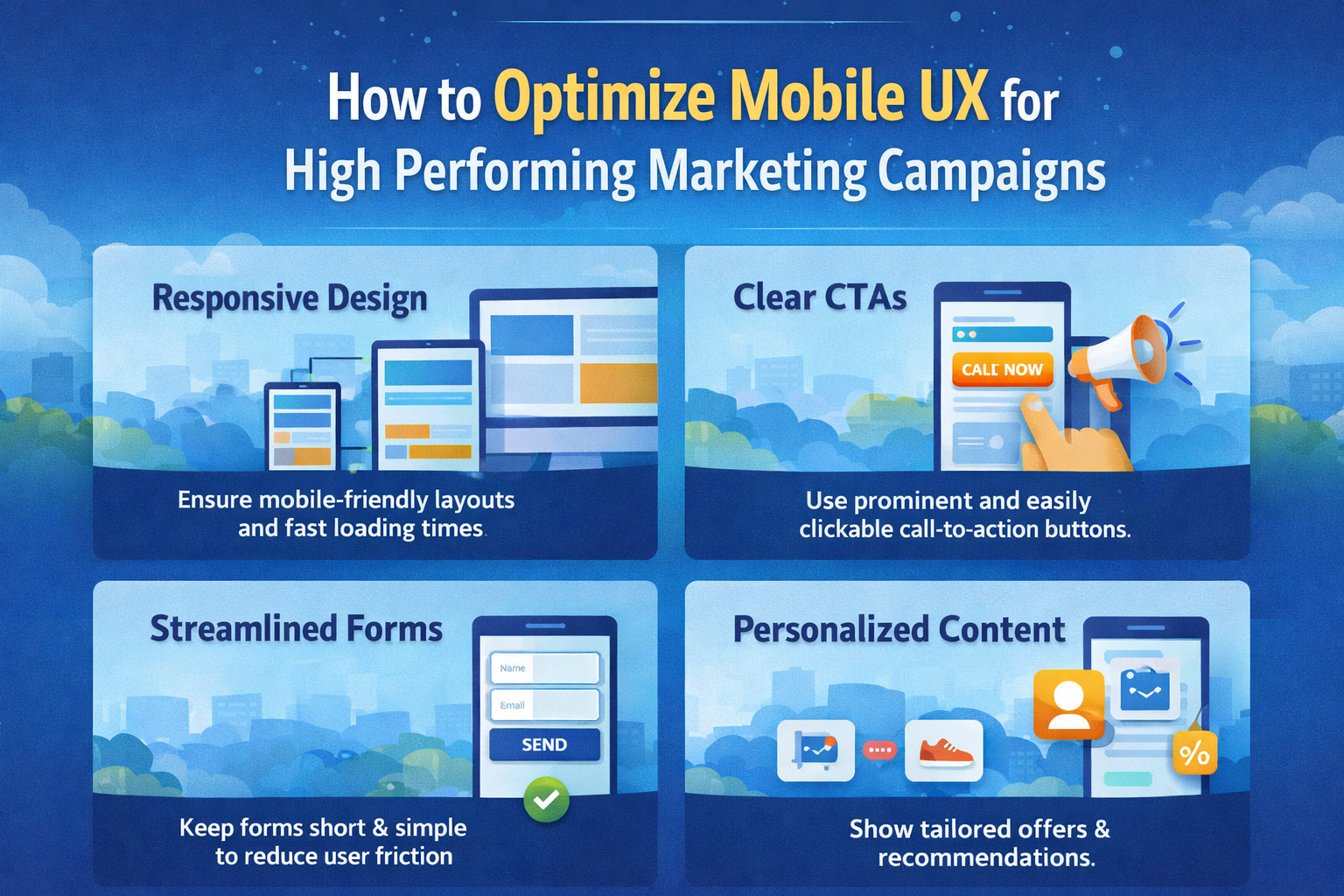
**Outline: How to Optimize Mobile UX for High Performing Marketing Campaigns**
Mobile optimization links directly to user experience (UX) and plays a huge role in marketing campaign performance. Growth marketers see that most digital users now access campaigns on mobile devices, making responsive design and fast load speeds essential.
Google research shows that as page load time increases from one to five seconds, bounce rates rise by 90 percent. Touch-friendly interfaces and clear navigation help reduce these bounce rates while improving conversion rates.
Responsive design ensures content adapts to any screen size, meeting customer expectations for usability and accessibility. Optimizing images, using lightweight assets, and designing tap-friendly CTAs boost user engagement across all mobile platforms.
Mobile-optimized content with concise headlines keeps messages clear and actionable for visitors who skim on small screens. Focusing on user needs creates engaging experiences that drive better retention, higher engagement metrics, and improved campaign results every time.
Introduction
Many marketers struggle when their mobile campaigns don’t get the clicks, sign-ups, or sales they expect. In fact, mobile user experience optimization for marketing campaigns is one of the biggest drivers of higher conversion rates and engagement today. This article shows you simple ways to make your mobile marketing easier to use and more effective for everyone who visits. Want to see better results from your next campaign? Keep reading.
Key Takeaways
- Most users access marketing campaigns on mobile devices, so responsive design and fast load times are essential. Google found that bounce rates rise by 90% if page loads go from one to five seconds.
- Touch-friendly interfaces and clear navigation improve user experience (UX), lower bounce rates, and increase conversion rates.
- Optimized images, lightweight assets, concise headlines, and mobile-friendly forms boost engagement across all platforms.
- Personalization and location-based targeting make campaigns more relevant. Marketers can use data analytics to understand customers’ needs better.
- Use key metrics like conversion rate, engagement rate, and bounce rate; apply A/B testing for improvements; stay updated with trends like AR, voice search, and AI enhancements to keep your mobile marketing effective.
The growing dominance of mobile in marketing
Mobile marketing continues to gain momentum. Businesses now prioritize mobile optimization because user experience (UX) directly impacts success. Most users access websites through their smartphones, making responsive design essential in today’s landscape.
Fast load times enhance engagement and reduce bounce rates significantly.
Touch-friendly interfaces grab attention and encourage interaction. High-quality content that fits mobile screens boosts performance and conversion rates. Growth marketers must focus on creating engaging experiences tailored for mobile users.
A seamless navigation process leads to better customer loyalty and retention, driving effective marketing campaigns forward.
Why user experience (UX) on mobile matters for campaign success
User experience (UX) on mobile plays a crucial role in the success of marketing campaigns. Mobile optimization significantly impacts how users navigate, read, and interact with content.
A seamless UX can directly reduce bounce rates by improving visitor engagement with websites and applications. Fast page load speeds enhance user satisfaction, making it easier for them to stay on your site.
Research shows that pages that load slowly lead to higher abandonment rates.
Responsive design is essential for businesses today. It allows websites to adapt smoothly across various devices, ensuring all users have a positive experience regardless of screen size.
Touch-friendly interfaces also maximize engagement by allowing easy interaction with content. Focusing on user needs during mobile UX design leads to better usability and accessibility; this results in increased customer loyalty and retention over time.
Core Principles of Optimizing Mobile UX
Optimizing mobile UX starts with responsive design. This approach ensures that your content adapts seamlessly across different devices.
Responsive design and device adaptability
Responsive design is crucial for mobile optimization. It allows websites to adjust their layout based on the user’s device. This adaptability directly improves user experience (UX).
Users can easily navigate, read, and interact with content. Mobile devices account for a significant portion of online traffic. If your site isn’t responsive, you risk high bounce rates.
Touch-friendly interfaces enhance user engagement significantly. Growth marketers should prioritize responsive design as a best practice. A well-designed mobile site meets customer expectations and boosts conversion rates.
Investing in this aspect leads to better usability and accessibility, which builds customer loyalty over time.
Fast load times and lightweight assets
Fast load times enhance mobile user experience (UX). Users quickly lose interest if a page takes too long to load. Page speed significantly impacts engagement and overall performance.
Marketers must optimize their content for speed by using lightweight assets. Heavy images or complex files can slow down pages, leading to higher bounce rates.
Improving mobile sites requires careful selection of design elements. Ensure that video advertising and images are optimized for quick loading while maintaining quality. Simple navigation further supports this goal.
Businesses aiming to succeed in today’s competitive landscape should focus on responsive designs that prioritize fast load times and user engagement. A seamless experience boosts conversion rates and fosters customer loyalty.
Intuitive navigation and clear signposting
Intuitive navigation and clear signposting are critical for improving mobile user experience (UX). A well-structured interface allows users to find what they need quickly and easily.
Good mobile UX improves usability and accessibility, leading to better customer loyalty. Clear pathways help users understand their options without confusion.
Mobile optimization reduces bounce rates by enhancing how visitors interact with your site or app. Touch-friendly interfaces make it easy for users to engage with content. Prioritizing user needs in design boosts engagement metrics significantly.
By focusing on intuitive navigation, marketers create smoother journeys for customers, which enhances overall conversion rates.
Accessibility and scannability for diverse users
Accessibility ensures that all users can engage with your content. Focus on creating user-friendly layouts that accommodate different abilities and preferences. Implementing mobile optimization strategies enhances navigation for everyone, including those with disabilities.
Scannability plays a key role in keeping users engaged. Use headings, bullet points, and short paragraphs to make information easy to find. Good content legibility improves how visitors interact with websites and applications.
Prioritizing these elements boosts conversion rates and overall performance of marketing campaigns.
Designing High-Impact Content and Interactions
Creating tap-friendly layouts and engaging interactive elements ensures that users connect with your content effortlessly. Use mobile-optimized forms and compelling calls to action to boost conversions.
Choose images, videos, and copy that resonate well on small screens for maximum impact. Focus on crafting concise, attention-grabbing headlines to draw in your audience. Explore more strategies to elevate your mobile marketing game!
Tap-friendly layouts and interactive elements
Tap-friendly layouts enhance user experience by making content easily accessible. Users can interact effortlessly with buttons and links, which boosts engagement. Touch-friendly interfaces are crucial for mobile UX optimization.
They maximize user interactions and reduce bounce rates. Clear call-to-action buttons improve conversion rates significantly.
Interactive elements add value to the mobile browsing experience. Users prefer engaging features like sliders or quizzes that invite them to participate actively. These enhancements keep visitors on your site longer, leading to better performance in marketing campaigns.
Understanding user preferences lets marketers craft experiences that captivate their audience effectively.
Mobile-optimized forms and CTAs
Mobile-optimized forms and calls to action (CTAs) are crucial for user engagement. These elements need a simple design that encourages easy interaction. Touch-friendly interfaces help users complete tasks quickly.
Clear labels, large buttons, and minimal fields improve usability. Engaging CTAs drive conversions by guiding users toward desired actions.
Optimizing these features directly enhances user experience (UX). Fast-loading forms lead to higher conversion rates since visitors stay engaged longer. Reducing bounce rates becomes easier when you simplify the process of filling out forms or clicking CTAs.
Focus on user preferences to create friendly experiences that capture attention and boost performance metrics for mobile marketing campaigns.
Effective use of mobile-friendly images, videos, and copywriting
Using mobile-friendly images, videos, and copywriting directly impacts engagement. Good visuals enhance content legibility and attract users. Images should be optimized for fast loading times to prevent user frustration.
Videos must be concise and captivating to hold attention on small screens.
Effective copywriting communicates clearly and grabs interest quickly. Focus on short sentences that convey messages without clutter. Users appreciate straightforward language that speaks to their needs.
Optimizing all these elements reduces bounce rates and boosts conversion rates significantly in mobile marketing campaigns.
Crafting concise, attention-grabbing headlines and messages
Craft concise, attention-grabbing headlines to boost engagement. Use clear language and powerful words that resonate with users. Good mobile UX focuses on content legibility. Headlines should grab attention quickly because mobile users scan results fast.
Effective messages are direct and get straight to the point, which increases conversion rates.
Emphasize user needs in your copywriting for better impact. High-performing marketing campaigns rely on understanding what engages customers most. A well-crafted headline can improve usability by guiding users seamlessly through their journey.
Tapping into these strategies enhances overall performance in mobile advertising efforts moving forward.
Mobile Marketing Strategies to Boost Performance
Mobile marketing strategies play a crucial role in enhancing your campaign’s effectiveness. Use personalization and location-based targeting to connect with your audience more meaningfully.
Personalization and location-based targeting
Personalization and location-based targeting enhance user engagement in mobile marketing. Growth marketers can optimize content based on user preferences and geographical data. This strategy directly reduces bounce rates by creating more relevant experiences for users.
Engaging with customers in their local context increases the likelihood of interaction with mobile ads.
Marketers should leverage data analytics to understand customer journeys better. Location-specific offers resonate well since they meet immediate needs, leading to improved conversion rates.
Incorporating personalized elements into mobile UX makes it easier for users to navigate and find what they want quickly. As a result, businesses see higher performance from their marketing campaigns when they focus on these strategies.
Mobile-specific ad formats and placement
Mobile-specific ad formats boost engagement and enhance visibility. Marketers create ads that fit smaller screens, making them easy to interact with on mobile devices. Touch-friendly interfaces play a vital role in this strategy.
They ensure users can easily tap on ads without frustration.
Proper placement of these ads is crucial for success. Positioning them where users naturally scroll increases interaction rates. Ads must not disrupt the user experience; instead, they should blend seamlessly into content.
Responsive design also supports better viewing experiences, reducing bounce rates significantly. This approach not only improves usability but leads to higher conversion rates as well.
Integrating smart notifications and deep linking
Integrating smart notifications and deep linking improves mobile user experience. Smart notifications keep users informed and engaged. They remind customers about products they showed interest in or offer personalized updates.
Deep linking allows direct access to specific content within an app or website. This reduces bounce rates and enhances navigation by guiding users exactly where they want to go.
Mobile optimization significantly benefits from these strategies. Companies can increase conversion rates by making it easy for users to reach desired actions quickly. Understanding user preferences ensures the right content reaches the right audience at the right time, boosting engagement metrics effectively.
By focusing on clear communication through smart notifications, growth marketers can create a seamless journey for their customers using mobile devices.
Leveraging new technologies: AR, voice search, and AI enhancements
Smart notifications and deep linking set the stage for leveraging new technologies like AR, voice search, and AI enhancements. These innovations boost mobile user experience (UX) and create more engaging interfaces.
Augmented reality offers users immersive experiences that increase interaction with products. For example, brands can use AR to let customers visualize items in their own space before purchasing.
Voice search is becoming crucial as users prefer hands-free options. Optimizing content for this trend greatly improves content legibility and accessibility. AI enhancements allow businesses to analyze user preferences efficiently.
Tailored recommendations based on past behavior drive conversion rates higher than ever before. Marketers must embrace these cutting-edge tools to improve performance across their campaigns effectively.
Measuring, Testing, and Continually Improving Mobile UX
Analyze key metrics to assess your mobile campaign’s effectiveness. Use A/B testing to gather user feedback and make data-driven adjustments.
Key metrics for mobile campaign performance
Key metrics for mobile campaign performance include conversion rates, engagement rates, and bounce rates. These figures show how well your marketing efforts resonate with users. High conversion rates indicate that visitors complete desired actions, like making purchases or signing up for newsletters.
Track engagement metrics to see if users interact with your content through clicks or shares.
Monitoring bounce rates reveals how quickly users leave your site after viewing a single page. Lower bounce rates often mean improved navigation and user experience (UX). Good mobile UX enhances usability and accessibility, leading to better customer loyalty and retention.
Focus on these key metrics to optimize mobile campaigns effectively.
A/B testing and user feedback loops
A/B testing helps marketers identify what works best for their mobile audience. Growth marketers can test different versions of a webpage or ad to see which one performs better in terms of conversion rates and user engagement.
By analyzing metrics from these tests, they gain insights into user preferences.
User feedback loops provide direct input from users about their experiences. This feedback guides improvements in navigation, visual design, and overall mobile UX. Understanding how visitors interact with content leads to higher performance in marketing campaigns; it also reduces bounce rates by making sites more engaging and user-friendly.
Iterative design based on analytics
Iterative design based on analytics drives mobile optimization. It helps marketers understand user preferences and behavior. By analyzing key metrics, marketers can refine their strategies to improve UX.
Frequent testing reveals how visitors interact with websites and applications.
This process reduces bounce rates by making navigation smoother. Good mobile UX leads to higher user engagement and better conversion rates. Growth marketers should focus on performance analytics to enhance usability and accessibility in their campaigns.
These adjustments create a more engaging experience, fostering customer loyalty over time.
Staying current with evolving mobile trends and tech
Staying updated with mobile trends and tech is vital for growth marketers. Mobile optimization connects directly to user experience (UX). Users expect dynamic, responsive designs that enhance navigation and content legibility.
Fast page load speeds significantly boost engagement; a slow site can drive users away.
New technologies like augmented reality (AR) and voice search influence how customers interact with brands. These innovations increase opportunities for personalization and location-based targeting in marketing strategies.
Marketers should focus on touch-friendly interfaces because they maximize user engagement. Prioritizing these elements reduces bounce rates while improving brand loyalty. Adapting to changing mobile landscape standards ensures better performance across campaigns, leading to higher conversion rates.
—
Staying current with evolving mobile trends and tech leads directly to effective marketing strategies. Mobile optimization plays a crucial role in enhancing user experience (UX). High-performing campaigns rely on seamless navigation.
Users must easily read, navigate, and interact with content without frustration.
Fast page load speed significantly boosts engagement rates. Slow sites cause users to leave before they even see your content. Responsive design is essential for businesses aiming for success in a mobile-first marketplace.
Touch-friendly interfaces also encourage interaction and maximize user engagement. Improved UX increases customer loyalty and retention both of which are key drivers of conversion rates.
FAQs
1. What is mobile optimization in marketing campaigns?
Mobile optimization means designing your site and ads for smartphones and tablets. It improves user experience UX, content legibility, and conversion rates by making everything easy to use on small screens.
2. How does responsive design affect user engagement?
Responsive design lets websites adjust to any device size, which boosts performance and visual design quality. This encourages users to stay longer and increases engagement with your marketing strategy.
3. Why is navigation important for high-performing mobile campaigns?
Clear navigation helps users find what they need fast. When navigation works well on mobile devices, it leads to better conversion rate optimization because visitors can act without confusion or delay.
4. How do you improve content legibility for mobile ads?
Use large fonts, simple layouts, and clear visuals so text stays readable on phones or tablets. Good content legibility keeps users focused on your message and supports higher conversion rates.
5. What role does A/B testing play in optimizing the mobile user experience UX?
A/B testing compares two versions of a page or ad to see which one gets more clicks or sales. By using A/B testing as part of performance optimization, marketers can fine-tune their approach for maximum results across all devices.