


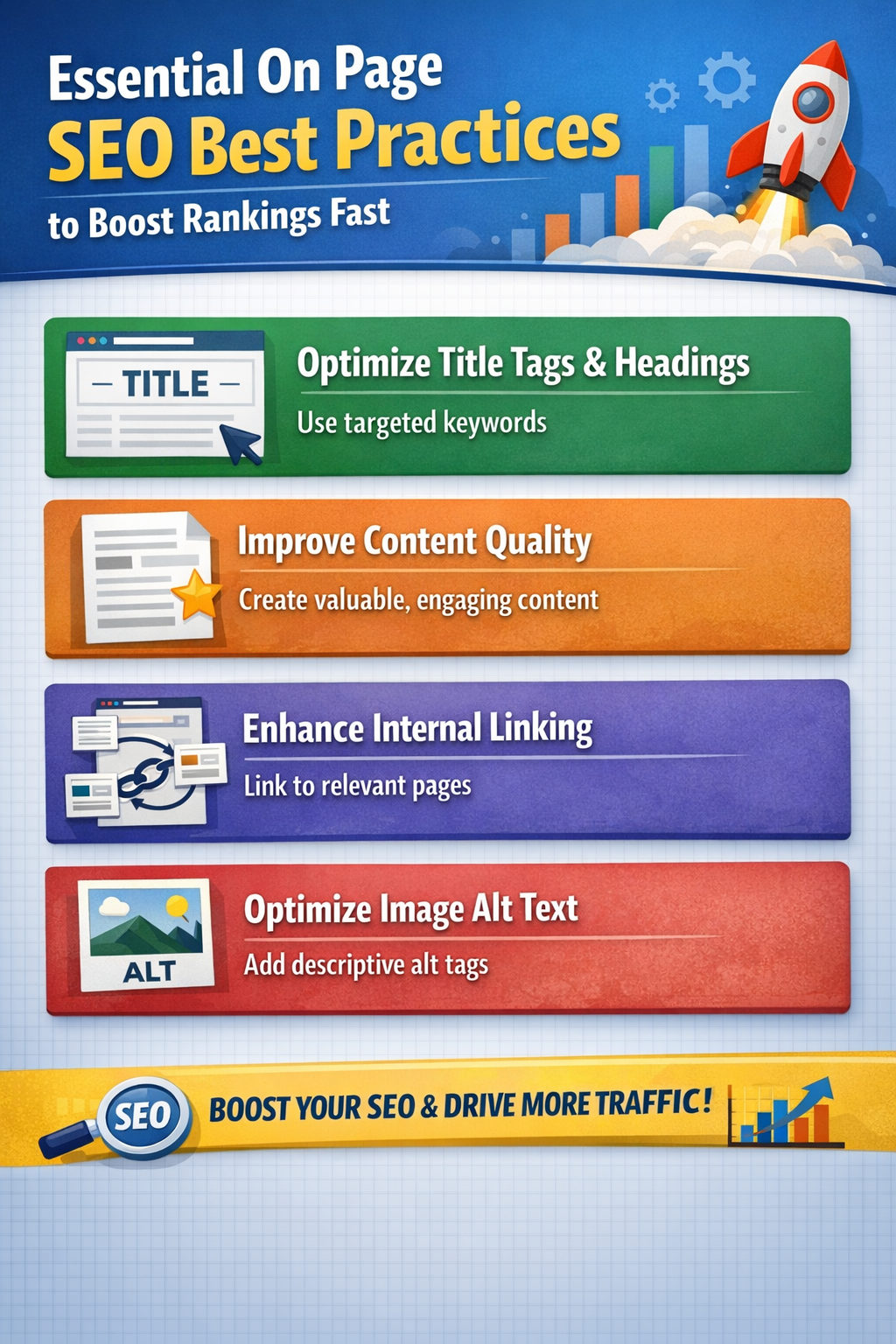
**Essential On-Page SEO Best Practices to Boost Rankings Fast**
On-page SEO involves optimizing your title tags, header tags, URLs, and website content to improve search engine rankings and drive targeted traffic. Effective keyword research helps structure pages for the right audience needs while also answering their intent.
Google’s quality signals now focus on E-E-A-T: Experience, Expertise, Authority, and Trustworthiness. High-quality content that demonstrates topical authority makes your site a credible source in any niche.
Mobile optimization is essential; over 60% of searches happen on mobile devices as of 2024. Fast-loading pages and clean URL structures support higher search visibility. Technical website optimization plays a key role too—improving site speed boosts user experience scores which impacts rankings directly.
An organized internal linking strategy lets search engines crawl deeper into your content directories while keeping users engaged longer. Use schema markup to make evergreen articles stand out in rich results on the SERP (Search Engine Results Page).
Regularly update an SEO checklist for sustained growth and top performance year-round.
Introduction
Boosting your website’s visibility can be tough. Many people struggle to understand how to improve their search rankings. This blog post showcases essential on-page SEO best practices for higher rankings.
You will find actionable tips that help increase traffic and enhance user experience. Read on to discover effective strategies!
Key Takeaways
- On-page SEO means optimizing title tags, header tags, URLs, and content to improve rankings fast. Over 60% of searches in 2024 come from mobile devices.
- Google’s ranking system uses E-E-A-T (Experience, Expertise, Authority, Trustworthiness) as quality signals for credible websites.
- Use strategic keyword clusters and update your content often to match user intent and boost topical authority.
- Improve user experience by making pages load faster and ensuring the site works on all devices. Add schema markup to enhance search results appearance (SERP).
- Create a strong internal linking structure with clear headings; link to reliable external sources; fix broken links regularly for better crawlability and higher rankings.
Briefly explain the importance of on-page SEO in achieving higher search engine rankings and driving targeted traffic.
On-page SEO plays a crucial role in boosting search engine rankings and attracting targeted traffic. It involves optimizing individual webpage elements such as title tags, header tags, URLs, and content quality.
These changes enable search engines to better understand your site’s structure and relevance. High-quality content that meets user intent enhances visibility. This approach positions your site as a credible source within your niche.
Focusing on user experience is essential for successful website optimization. Mobile responsiveness has become vital due to the growing number of users accessing the internet via mobile devices.
Implementing effective technical SEO strategies is critical for reaching higher rankings on Google and other platforms. Regularly updating content keeps it relevant, impacting overall traffic growth positively.
Optimize Content for User Intent and Quality
Optimize content by focusing on what users truly want and expect. Align your writing with strategic keyword clusters that capture their intent. Display your expertise and authority throughout the text to build trust.
Use clear headings for easy navigation, and keep your content fresh by updating it regularly. For more tips on enhancing your SEO strategy, continue reading!
Structure content around strategic keyword clusters
Effective SEO techniques start with structuring content around strategic keyword clusters. Focus on related keywords to create a natural flow of information. This approach aligns your content with searcher intent and expectations, making it easier for users to find what they need.
Grouping keywords helps you build topical authority. A well-organized structure enhances user experience and improves website optimization. Quality content that addresses specific topics leads to better search engine rankings.
Keep your audience in mind while developing this strategy to drive targeted traffic effectively.
Ensure content matches searcher intent and expectations
Following the structure of content around strategic keyword clusters, ensuring that your content matches searcher intent becomes vital. Audience understanding drives effective SEO practices for higher rankings.
Tailor your message to meet what users expect when they conduct a search. Your content should directly answer their questions or solve their problems.
Quality and authoritative information helps establish your site as a credible source within your niche. Focus on creating authentic content that aligns with user needs. This approach boosts both search engine rankings and user engagement, leading to improved traffic growth over time.
Showcase E-E-A-T (Experience, Expertise, Authority, Trustworthiness)
E-E-A-T stands for Experience, Expertise, Authority, and Trustworthiness. This concept helps you boost your website’s credibility in the eyes of search engines. Focus on creating quality content that showcases your knowledge and experience.
High-quality articles build trust with your audience and signal to Google that you are an authority in your niche.
Focusing on E-E-A-T improves your rankings significantly. It aligns with the SEO techniques needed for success today. Use real examples or data to demonstrate expertise within specific topics.
Authenticity matters; provide accurate information along with a well-structured presentation of ideas to strengthen user experience and site organization while enhancing traffic growth over time.
Use clear, organized headings and subheadings
Showcasing E-E-A-T (Experience, Expertise, Authority, Trustworthiness) leads to better user engagement. Using clear and organized headings and subheadings helps guide your audience through your content.
It can enhance the flow of information and make it easier for visitors to find what they want.
Properly structured headings improve SEO by signaling content hierarchy to search engines. They help crawlability too. Include targeted keywords within these headings for stronger relevance in searches.
Keeping a consistent style across all pages maintains professionalism and builds credibility with users while improving search engine rankings at the same time. By focusing on this organization, affiliate marketers will see improved traffic growth as their site becomes more accessible and user-friendly.
Regularly update and refresh content for relevance
Regularly updating and refreshing content boosts search engine rankings. Quality, authoritative, and authentic content remains fundamental for success on Google. Search engines favor fresh information; they reward sites that consistently provide updated material.
Affiliate marketers can drive traffic growth by revisiting their existing posts.
This practice enhances the relevance of the material and aligns with user intent. Focus on current trends in your niche to keep your audience engaged. By integrating keyword optimization into refreshed content, you improve visibility in SERPs as well.
Content quality matters greatly in the competitive landscape of SEO techniques today.
Perfect Your Metadata and On-Page Elements
Craft eye-catching title tags and meta descriptions that attract clicks. Use clear and keyword-focused URLs to help search engines crawl your pages. Organize content with a proper heading hierarchy for easy reading.
Enhance your site’s visibility by adding advanced schema markup to improve SERP features. Learn more about optimizing these elements effectively!
Write compelling, keyword-rich title tags and meta descriptions
Crafting compelling, keyword-rich title tags and meta descriptions boosts click-through rates significantly. These elements play a vital role in attracting users from search engine results pages (SERPs).
Focus on including essential keywords related to your content. This practice improves search visibility and aligns with user intent.
Each title tag should be concise, ideally under 60 characters. Meta descriptions should not exceed 160 characters for optimal display. Both must clearly describe the page’s content while enticing readers to click through.
High-quality, authoritative content contributes to better rankings on Google and other search engines as well.
Use descriptive, crawler-friendly URLs
Descriptive, crawler-friendly URLs improve your on-page SEO. They help search engines understand your content better while appealing to users. Use clear and relevant keywords in your URLs to enhance visibility.
A URL like “www.example.com/essential-on-page-seo” tells both users and crawlers what the page is about.
Search engine optimization relies heavily on quality content and user clarity. By developing a logical URL structure, you also boost site organization. This practice builds trust with visitors and improves navigation across your site.
Strong internal linking reinforces this effective strategy for driving traffic growth as well as improving search engine rankings.
Organize page content with proper heading hierarchy (H1, H2, H3)
Use a clear heading structure to organize your page content. Start with H1 for the main title, followed by H2 for major sections. Use H3 for subtopics within those sections. This approach helps search engines understand your content better.
It also improves readability for users, leading to a better user experience.
A well-structured heading hierarchy enhances SEO performance and boosts rankings as it aligns with how search engines scan pages. Proper headings guide readers through your content while emphasizing important keywords like “SEO techniques” and “site organization.” Next, focus on perfecting your metadata and on-page elements to maximize visibility in search results.
Add advanced schema markup to enhance SERP features
Continuing from organizing page content with proper heading hierarchy, advanced schema markup plays a crucial role in your on-page SEO. Schema helps search engines understand your content better and improves visibility.
This optimization technique enhances SERP features such as rich snippets or knowledge graphs.
Affiliate marketers and niche site builders should focus on adding structured data to their websites. Doing this boosts the chances of gaining higher click-through rates and attracting more traffic.
Quality, authoritative, and authentic content remains essential for success in Google’s rankings. So, using schema markup effectively aligns with optimizing user experience across your site while strengthening overall performance in search engine results pages (SERPs).
Enhance User Experience and Accessibility
Enhancing user experience boosts engagement and encourages visitors to stay longer. You can improve accessibility by ensuring your website is easy to navigate for all users, regardless of their abilities or devices.
Optimize for mobile devices and improve Core Web Vitals (speed, interactivity, stability)
Mobile optimization plays a vital role in on-page SEO. Websites must perform well on mobile devices since many users browse with smartphones and tablets. Improving Core Web Vitals enhances site speed, interactivity, and stability.
Search engines prioritize fast-loading sites that provide a seamless experience for users.
Strong performance in these areas can boost search engine rankings significantly. Users expect quick responses when they click links or navigate pages. Slow loading times frustrate visitors and increase bounce rates.
Focus on making your website mobile-friendly to drive traffic growth effectively while improving user experience across your site.
Use high-quality images with descriptive alt text
High-quality images enhance user experience and improve search engine rankings. Use vibrant visuals that relate closely to your content. These images should grab attention and provide value to viewers.
Include descriptive alt text for each image. This helps search engines understand the content of your visuals, boosting SEO performance.
Descriptive alt text also aids in accessibility by ensuring all users can engage with your site. It becomes crucial for optimizing user experience across your site; this strategy integrates seamlessly into best practices like keyword optimization and metadata enhancement.
Ensure accessibility for all users
Accessibility matters for every website. It helps all users navigate your site easily. Design your site with accessibility in mind to reach a wider audience. Use clear fonts and high contrasting colors to improve readability.
Add alt text to images so visually impaired users can understand their context.
Make sure that all interactive elements are keyboard-friendly. This change allows users who cannot use a mouse to engage with your content. Regularly test your website’s accessibility using tools designed for this purpose.
Improving user experience boosts engagement, which plays a vital role in search engine rankings and traffic growth.
Limit intrusive ads and distractions
Intrusive ads can drive users away from your site. They distract visitors and harm user experience. Affiliate marketers need to focus on creating a seamless browsing environment. Quality content should take center stage.
Technical SEO optimization becomes less effective if users are frustrated by constant pop-ups or flashy banners. Highlighting important information without overwhelming users fosters trustworthiness and authority.
This approach helps retain visitors, boosts time on the page, and enhances overall traffic growth. Next, examine ways to strengthen internal linking and site structure for better crawlability.
Strengthen Internal Linking and Site Structure
Create a clear internal linking strategy to help users and search engines navigate your site easily. Link related articles together to provide valuable context and keep visitors engaged longer.
Build a logical internal linking structure for better crawlability
Building a logical internal linking structure boosts your site’s crawlability significantly. This structure helps search engines find and index your pages more efficiently. Use relevant keywords to create clear connections between related content.
For example, link from an article about SEO techniques to one detailing keyword optimization.
Quality links lead users to additional information that enhances their experience. Solid internal links can establish topical authority while improving overall site organization. Ensure you regularly monitor these links for optimal performance and relevance in search engine rankings.
Next, focus on trustworthy external sources to strengthen your content further.
Link to trustworthy, relevant external sources
Linking to trustworthy, relevant external sources boosts your site’s credibility and authority. Search engines favor websites that provide accurate and reliable information. By connecting to reputable sites, you strengthen your content quality and improve search engine rankings.
This practice enhances user experience as well. Users appreciate finding valuable resources related to their queries. Including links directs them to further reading without leaving your site too much, improving engagement metrics.
Always choose high-quality sources for the best results in SEO techniques and overall website optimization.
Group related content in topical directories
Building a logical internal linking structure supports your SEO strategy. Grouping related content in topical directories strengthens this foundation. It helps users find relevant information quickly while also improving search engine rankings.
Well-organized content signals to search engines that your site holds authority on specific subjects.
Creating topical directories encourages visitors to explore more pages on your site, increasing engagement and reducing bounce rates. This group structure enhances user experience and drives traffic growth.
Prioritize quality over quantity when organizing these groups; relevance matters most for successful website optimization in affiliate marketing and niche sites.
Regularly monitor and update links for best performance
Maintaining an effective internal linking structure is vital for website optimization. Links can change over time, making regular monitoring essential. Update any broken links to improve user experience and ensure smooth navigation throughout your site.
A well-maintained link structure boosts search engine rankings significantly.
Checking links also helps in discovering new opportunities for keyword optimization. Link to fresh, authoritative sources that enhance the content quality on your pages. This strengthens topical authority within your niche and draws more targeted traffic.
Prioritize this practice to keep boosting rankings fast through effective SEO techniques.
FAQs
1. What are the essential on page SEO best practices to boost rankings fast?
To improve search engine rankings quickly, use keyword optimization, write high-quality content, and focus on user experience. Make sure your title tags and meta descriptions are clear. Organize your site well with a strong URL structure.
2. How does keyword research help website optimization?
Keyword research helps you find terms people search for online. When you add these keywords into your pages using proper SEO techniques, it drives more traffic growth to your website.
3. Why do title tags and meta descriptions matter for search engine results?
Title tags and meta descriptions tell users what each page is about in the SERP or Search Engine Results Page. Well-written meta tags increase clicks and support higher rankings.
4. How can internal linking improve user experience and SEO?
Internal linking guides visitors through related content within your site organization; this keeps users engaged longer while helping search engines understand which pages matter most.
5. What role does mobile-friendly design play in on-page SEO?
A mobile-friendly design ensures that all visitors enjoy a smooth user experience across devices; this leads to better engagement metrics that influence overall website optimization and ranking potential.
6. How do I avoid duplicate content issues when optimizing my web pages?
You should create unique content for each page during content optimization efforts; always check for repeated text so that every section adds value according to proper SEO audit standards.